> ## Documentation Index
> Fetch the complete documentation index at: https://help.fieldpulse.com/llms.txt
> Use this file to discover all available pages before exploring further.
# Customer Account Structures Overview
> Compare parent/child and multi-location customer structures in FieldPulse to control billing hierarchy or track one customer's many service addresses.
> **Who uses this:** Anyone who creates or edits customer records in FieldPulse. **Availability:** All regions.
FieldPulse has two account structures for a [customer](https://www.fieldpulse.com/features/customer-management) that is bigger than one name at one address: a **parent/child relationship** for hierarchical billing control, and **multi-location** for one customer with several service addresses. Choose parent/child when you need to control who ultimately pays. Choose multi-location when one customer has many service addresses but one bill.
## Overview
Customer account structures are two ways to organize a customer that is really an umbrella — a property manager who pays for ten units, or a restaurant chain that runs jobs at fifteen locations under one contract. Log every unit as a standalone customer and the billing loses its hierarchy; put everything under one address and you lose the job history per site. The parent/child relationship and multi-location each solve one version of that problem.
| **Feature** | **Parent/child relationship** | **Multi-location** |
| -------------------------- | ---------------------------------------------------------- | -------------------------------------------------------------------------------------------- |
| **Primary purpose** | Manage hierarchical billing control (who ultimately pays). | Manage multiple service addresses under one customer. |
| **QuickBooks sync impact** | Parent and child sync as distinct customers. | Only the original customer record syncs. Additional locations are housed only in FieldPulse. |
| **Billing flexibility** | Override billing by job. | Billing is always tied to the original customer. |
| **Best for** | Property management and flexible billing needs. | Commercial customers with multiple locations. |
Both structures organize your *customers*. Neither one is a franchise structure, where a franchisor oversees independent franchisee accounts — see [Franchise Overview](/settings/account-structures/franchise-overview) — and neither one is a master account, where one operator switches between their own separate businesses — see [Master Account Overview](/settings/account-structures/master-account).
## How it works
Both structures are built on the customer record, and the difference shows up in your accounting. A parent and a child sync to QuickBooks as two distinct customers; additional locations added to one customer record stay in FieldPulse.
### Parent/child relationships
The parent/child structure is a hierarchical system where one main account oversees several smaller accounts.
* **Parent** — the primary account, such as a corporate office or property management company. This is usually the main billing entity.
* **Child** — the individual service location, such as a specific condo unit or property site.
Use a parent/child relationship when you need corporate oversight and tracking, and when both entities should operate as separate customers in QuickBooks. Common setups:
* **Property management** — a management company (parent) oversees several apartment complexes (children).
* **Condo or unit billing** — the management company is the parent, and it bills individual homeowners or tenants (children) directly.
* **Corporate contracts** — a restaurant chain where multiple locations are managed under one corporate umbrella.
The key advantage is flexible job-specific billing: you can bill the service address (child) while keeping the option to bill the main corporate office (parent) when needed.
To establish a parent/child relationship:
1. Open the parent customer's record — for example, the management company.
2. Go to the **Related Customers** tab.
3. Select **Link Customer** — the chain icon — to connect a customer that already exists, or select **Create Customer** to add a new child account.
4. Set the default billing by confirming the correct billing address on the child's profile. Turn on the **Use Separate Billing Address** toggle to override the default parent address.
 To bill a child's estimates and invoices directly to the parent account — including charging the parent's card on file — see [Bill to Parent](/estimates-invoices/creating/bill-to-parent) for the full billing workflow.
For the full walkthrough of linking one customer record to another, see [How to Create Related Customers](/customers/managing-customers/creating-related-customers).
### Multi-location
Multi-location is a feature that lets you add multiple service addresses to a single primary customer record. All service history is tracked under the original customer account, and these additional addresses **do not** sync to QuickBooks — they stay within FieldPulse.
Use multi-location when a single customer, often in a commercial setting, has multiple locations. Common setups:
* **Commercial complexes** — track jobs by specific tenant locations without cluttering your QuickBooks records.
* **Simple location tracking** — keep your QuickBooks customer list clean while holding detailed service data in FieldPulse for internal use.
The key advantage is a clean QuickBooks sync: one customer record in QuickBooks carries all financial transactions, which prevents unnecessary data clutter.
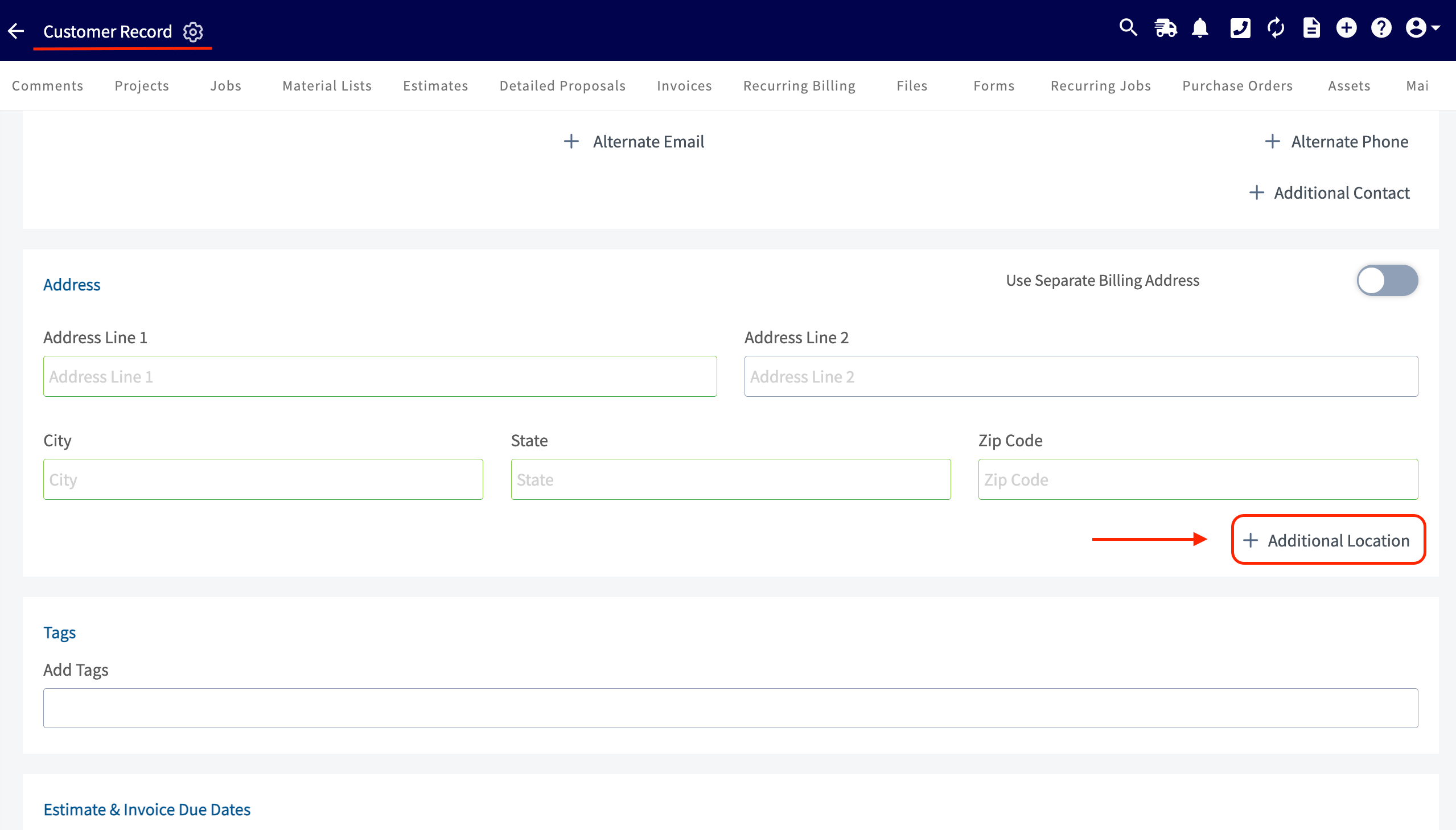
To set up multi-location on a customer record:
1. Open the original customer's record.
2. Go to the **Address** section of the customer record.
3. Select **Additional Location** to add each service address.
To bill a child's estimates and invoices directly to the parent account — including charging the parent's card on file — see [Bill to Parent](/estimates-invoices/creating/bill-to-parent) for the full billing workflow.
For the full walkthrough of linking one customer record to another, see [How to Create Related Customers](/customers/managing-customers/creating-related-customers).
### Multi-location
Multi-location is a feature that lets you add multiple service addresses to a single primary customer record. All service history is tracked under the original customer account, and these additional addresses **do not** sync to QuickBooks — they stay within FieldPulse.
Use multi-location when a single customer, often in a commercial setting, has multiple locations. Common setups:
* **Commercial complexes** — track jobs by specific tenant locations without cluttering your QuickBooks records.
* **Simple location tracking** — keep your QuickBooks customer list clean while holding detailed service data in FieldPulse for internal use.
The key advantage is a clean QuickBooks sync: one customer record in QuickBooks carries all financial transactions, which prevents unnecessary data clutter.
To set up multi-location on a customer record:
1. Open the original customer's record.
2. Go to the **Address** section of the customer record.
3. Select **Additional Location** to add each service address.
 To add contacts alongside those service addresses, see [How to Manage Multi-Location & Multi-Contact Customers](/customers/managing-customers/multi-location-multi-contact).
## Still need help?
Contact the FieldPulse support team at [support@fieldpulse.com](mailto:support@fieldpulse.com) or use the chat feature in the bottom-right corner of your screen.
## Related articles
* [How to Create Related Customers](/customers/managing-customers/creating-related-customers)
* [How to Manage Multi-Location & Multi-Contact Customers](/customers/managing-customers/multi-location-multi-contact)
* [Franchise Overview](/settings/account-structures/franchise-overview)
* [Master Account Overview](/settings/account-structures/master-account)
## Related topics
- [Account Structures & Franchises](/settings/account-structures/index.md)
- [Master Account Overview](/settings/account-structures/master-account.md)
- [Franchise Overview](/settings/account-structures/franchise-overview.md)
- [Franchise Royalty Reporting Overview](/settings/account-structures/franchise-royalty-reporting.md)
To add contacts alongside those service addresses, see [How to Manage Multi-Location & Multi-Contact Customers](/customers/managing-customers/multi-location-multi-contact).
## Still need help?
Contact the FieldPulse support team at [support@fieldpulse.com](mailto:support@fieldpulse.com) or use the chat feature in the bottom-right corner of your screen.
## Related articles
* [How to Create Related Customers](/customers/managing-customers/creating-related-customers)
* [How to Manage Multi-Location & Multi-Contact Customers](/customers/managing-customers/multi-location-multi-contact)
* [Franchise Overview](/settings/account-structures/franchise-overview)
* [Master Account Overview](/settings/account-structures/master-account)
## Related topics
- [Account Structures & Franchises](/settings/account-structures/index.md)
- [Master Account Overview](/settings/account-structures/master-account.md)
- [Franchise Overview](/settings/account-structures/franchise-overview.md)
- [Franchise Royalty Reporting Overview](/settings/account-structures/franchise-royalty-reporting.md)