
Who uses this: Users with FieldPulse Payments access — the user roles you grant access to when your application is approved, plus per-user access set under Company Settings > User Accounts. Availability: FieldPulse Payments is available to businesses located in the United States. ACH on file has to be turned on by a FieldPulse team member.A saved payment method is a customer’s credit card or ACH bank account stored on their customer record. Once a method is on file, you can charge it for a one-off invoice or set it as the automatic payment for recurring billing, without asking the customer for the details every time you bill them. Every saved payment method is tokenized, so card numbers and bank account numbers stay protected.
Overview
Saving payment methods on file is included with FieldPulse Payments. Cards and bank accounts show together in a single, scannable list on the customer record, each one with the brand or bank icon, the last 4 digits, and either an expiry date (cards) or the account type — checking or savings (ACH). You can put a method on file from the customer record, or save it while you collect a payment. Once it is stored, you can charge it from an invoice on the web app or the mobile app, or set it as the payment method on a recurring billing record.Video walkthrough
Watch the walkthrough, then follow the written steps below.Video walkthrough: saving a payment method on file
Before you begin
- FieldPulse Payments has to be enabled on your account. See FieldPulse Payments Overview.
- For ACH on file, a FieldPulse team member has to turn ACH on. Reach out through chat support, or contact your Customer Success Manager directly if you have Premium Support. While ACH is off, only credit card options appear when you save a payment method.
Recommended: Turn on Next-Day Funding for the fastest deposits. With it on, ACH payments from bank accounts verified through Plaid deposit in 1 business day; ACH payments from unverified accounts take about 4 business days.
On web
Add a payment method to a customer record
Add a card or bank account directly to a customer’s profile. The starting point depends on whether the customer already has a method on file. If no payment method has been saved to this customer record yet:- Open the customer record.
-
In the Saved Payment Methods field, select + Add New Payment Method.
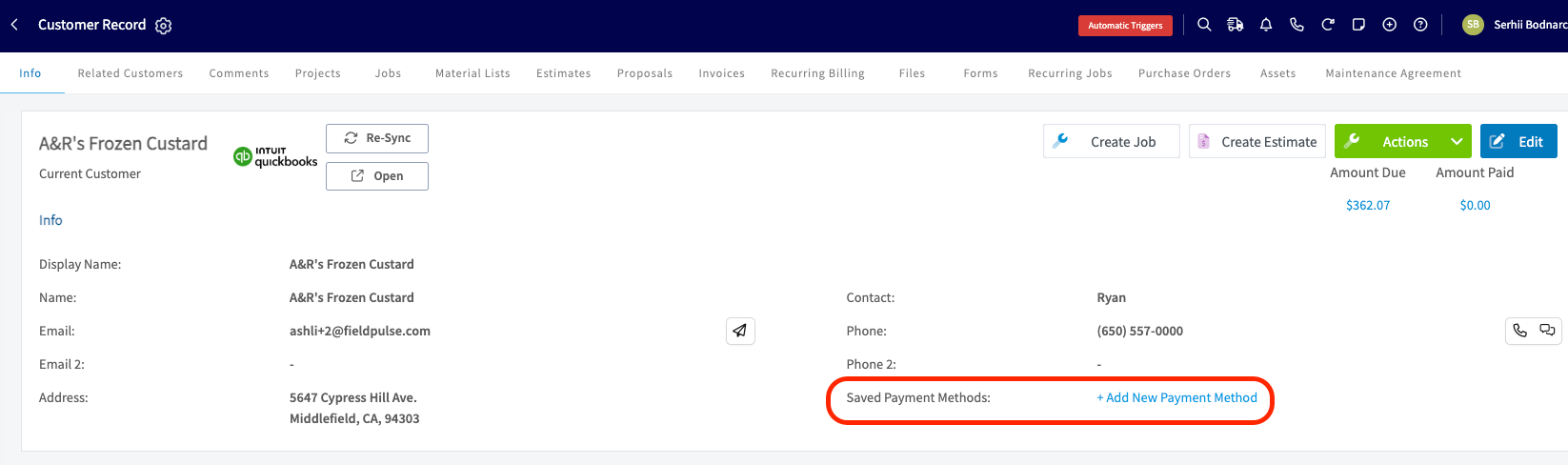
- Choose card or bank account, enter the details, and check the consent box — I confirm that I have obtained consent to store this payment information for future transactions.
- Select Save Payment Method. FieldPulse tokenizes the details and stores the method on the customer’s record.
- Open the customer record.
-
In the Saved Payment Methods field, select the payment method numbers, or View All if more than one method is stored.
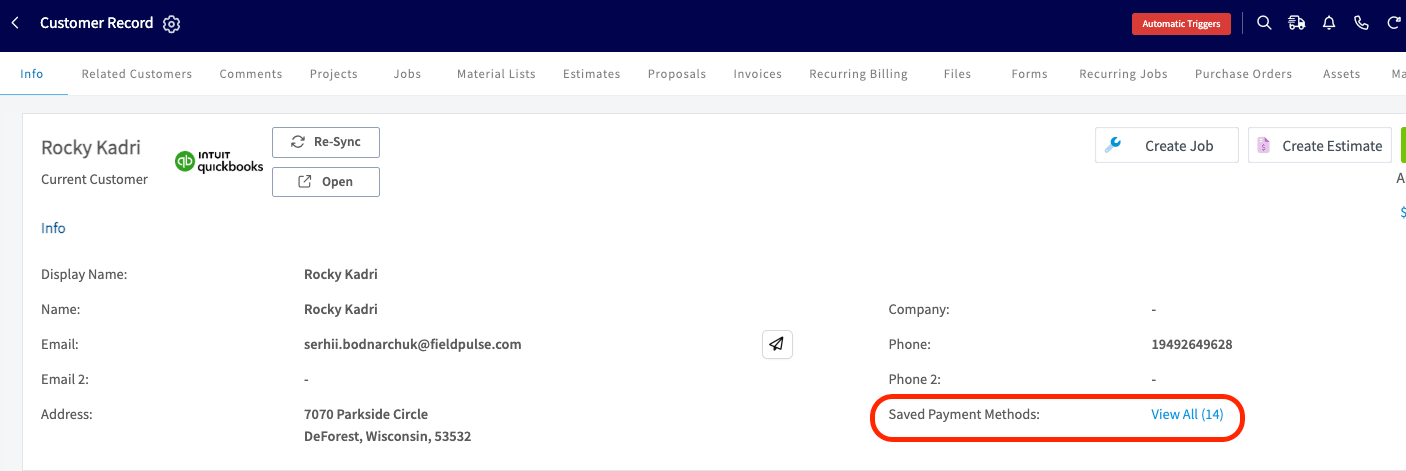
-
In the Manage Payment Methods drawer, select + Add New Payment Method.
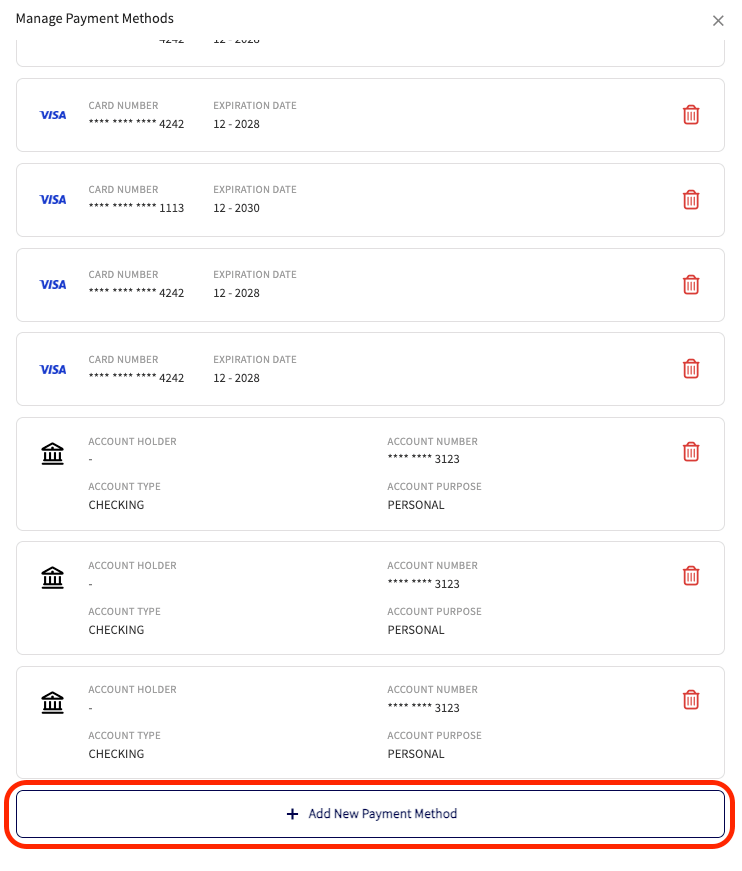
- Choose card or bank account, enter the details, and check the consent box.
- Select Save Payment Method.
Add a payment method while collecting a payment
You can also save a method as part of a payment you are already taking, so the card or bank account is on file for next time.- On an invoice, select Payment, then the Take Payment tab.
- Enter the card or bank details, then toggle on Save Payment Method on File and check the consent box.
- Select Charge Payment Method. FieldPulse processes the transaction and saves the method to the customer’s record.
Charge a saved payment method
Charge a method already on file from the invoice you want to collect on.- On an invoice, select Payment, then the Take Payment tab.
- Select Use Saved Payment Method, then choose the card or bank account from the list. Each one shows its brand or bank icon, the last 4 digits, and either expiry or account type.
- Select Charge Payment Method to run the transaction.
View and remove saved payment methods
Every method saved for a customer lives in the Manage Payment Methods drawer on that customer’s record.- Each saved method appears as its own card in the drawer. To remove one, select the trash icon and confirm in the pop-up.
- Saved payment methods cannot be edited. To change a card or bank account, delete it and add it again.
- Expired cards show a red expiry date with an error icon, so you can spot them at a glance.
- If you disable ACH later, saved ACH methods are hidden from view. Re-enable ACH with the support of the FieldPulse team and they reappear.
Use a saved payment method for recurring billing
Saved payment methods power recurring billing too, including ACH. When you create or edit a recurring billing record:- In the Payment Details section, set Payment Option to Automatically charge a saved payment method.
- Choose the method under Payment Method. If the customer has only one method on file, it auto-fills; if they have several, pick the one you want to charge.
- To add a new method on the spot, select Enter Payment Method and enter a card or bank account. Whatever you save there also lands in the customer’s Saved Payment Methods for future use.
- Save the Recurring Billing record. FieldPulse runs the payment on your schedule against the method you selected, until the end date or until you remove it.
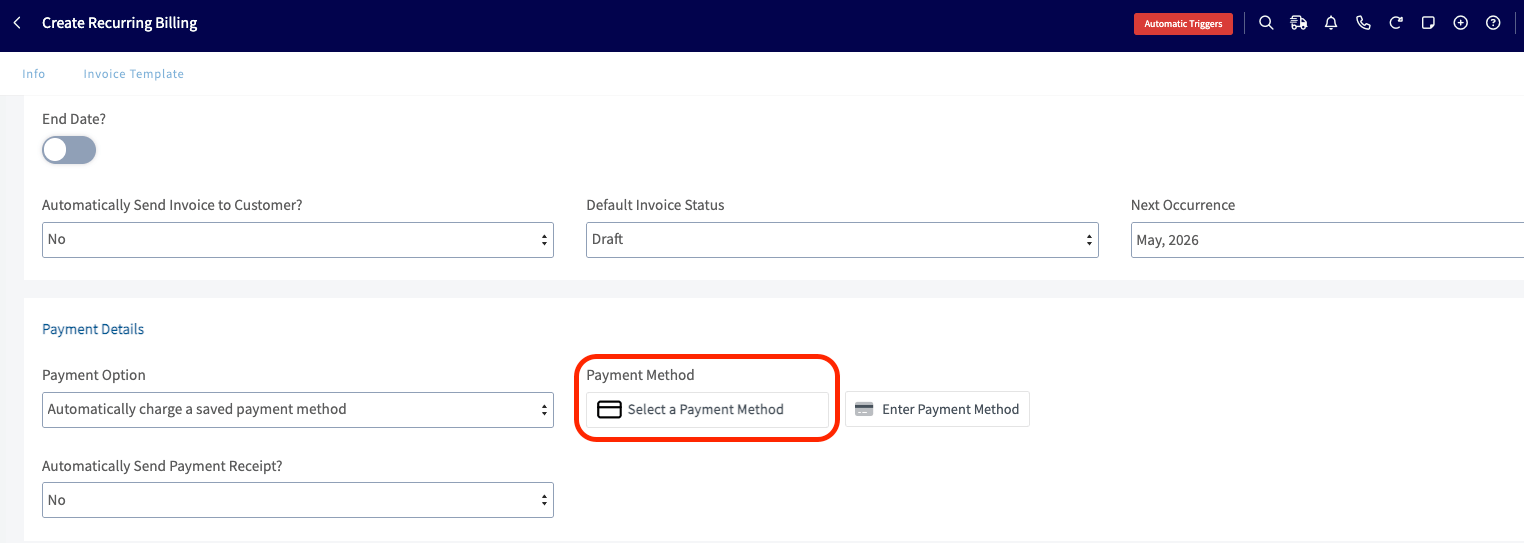
Recurring Billing setup is web app only.
On mobile
Charge a saved payment method in the field
Collect on an invoice with a card or bank account the customer already has on file.- Tap Payment on the invoice and choose Use saved payment method.
- Pick the card or bank account you want to charge from the list. Each one shows its brand or bank icon, the last 4 digits, and either expiry or account type, so you can confirm with the customer at a glance.
- Tap Charge Payment Method to run the transaction.
Add a new payment method on the job
Take a new card or bank account in the field and keep it on file at the same time.- Tap Add New Payment Method and enter the card or bank details.
- To save the method for next time, toggle on Save Payment Method on File and check the consent box — I confirm that I have obtained consent to store this payment information for future transactions.
- Tap Charge Payment Method to complete the transaction. The method is now saved to the customer’s record, ready for the next time you bill them.